Okay, so let’s talk about hiring, because I think this is one of those things a lot of business owners don’t really understand until they actually bring somebody into the business.
A lot of online business owners came up during that 2019, 2020, 2021 run when the online business industry was booming. Coaches, consultants, service providers, everybody was figuring out how to make money online. People were buying, people were selling, and people were becoming millionaires who had never millioned a day in their lives. The money was there, the opportunity was there, and for a while a lot of stuff could work simply because everybody was trying to figure out something they could do to make money and keep things moving.
So you could wing some things. You could have a process that only made sense to you and still make money. You could have leads coming in from everywhere, be a little loose with follow-up, have information living in five different places, and somehow keep the business moving because there was enough activity coming through to cover a lot of the gaps.
But fast forward and the economy is different. The buying environment is different, the requirements are different, and the way people make decisions about where they spend their money is different. So now you have to be more strategic with your leads, more strategic with your outreach, more strategic with your client selection and more intentional about what actually happens once somebody comes into your business.
The good thing is, if you’ve been doing this for a while, you’ve probably built some recognition. People know your name. They’ve seen your content, watched you work, referred people to you or worked with you before. You’ve built that know, like and trust online, and maybe locally too. But now you’re at that point where the business is harder to manage by yourself. Some of you have jobs again while still running the business. Some of you have more clients than you used to. Some of you are still doing the marketing, sales, delivery, client communication, admin, follow-up and whatever else lands on your plate that day.
So you’re like, okay, boom. The next step that makes the most logical sense is hiring. Let me go get an executive assistant or a VA and get some of this stuff off my plate.
Then you hire them and now you’re looking at her, she’s looking at you, y’all are looking back and forth at each other like… okay, so what exactly are we doing here?
Because in your head, you thought hiring somebody was the part that was going to make things easier. But this is your business. It was originally structured around you, and whatever systems you have in place are the systems that worked for you.
And I hear business owners say all the time that they don’t have systems or that their systems don’t work. The thing is, if you have a business that’s operating and making money, you have systems. Whether you sat down and strategically and intentionally designed those systems is a completely different story, but the systems exist. Something happens when a lead comes in. Something happens when somebody pays. Something happens when a client needs something. Something happens when the work is complete. Even if the answer is “I remember what to do and then I do it,” that’s still the way the business currently operates.
Sometimes the system is in your CRM. Sometimes it’s in a Google Doc. Sometimes it’s in an email thread, five different apps or a notebook somewhere. And sometimes the whole damn system is in your head.
That can work when you’re the only person who needs to understand it, because you know what happens next. You know which client needs a little extra communication, what can wait until tomorrow, what absolutely can’t, what you need to approve and what you don’t. You know the random little exceptions nobody ever wrote down because there was never a reason to write them down.
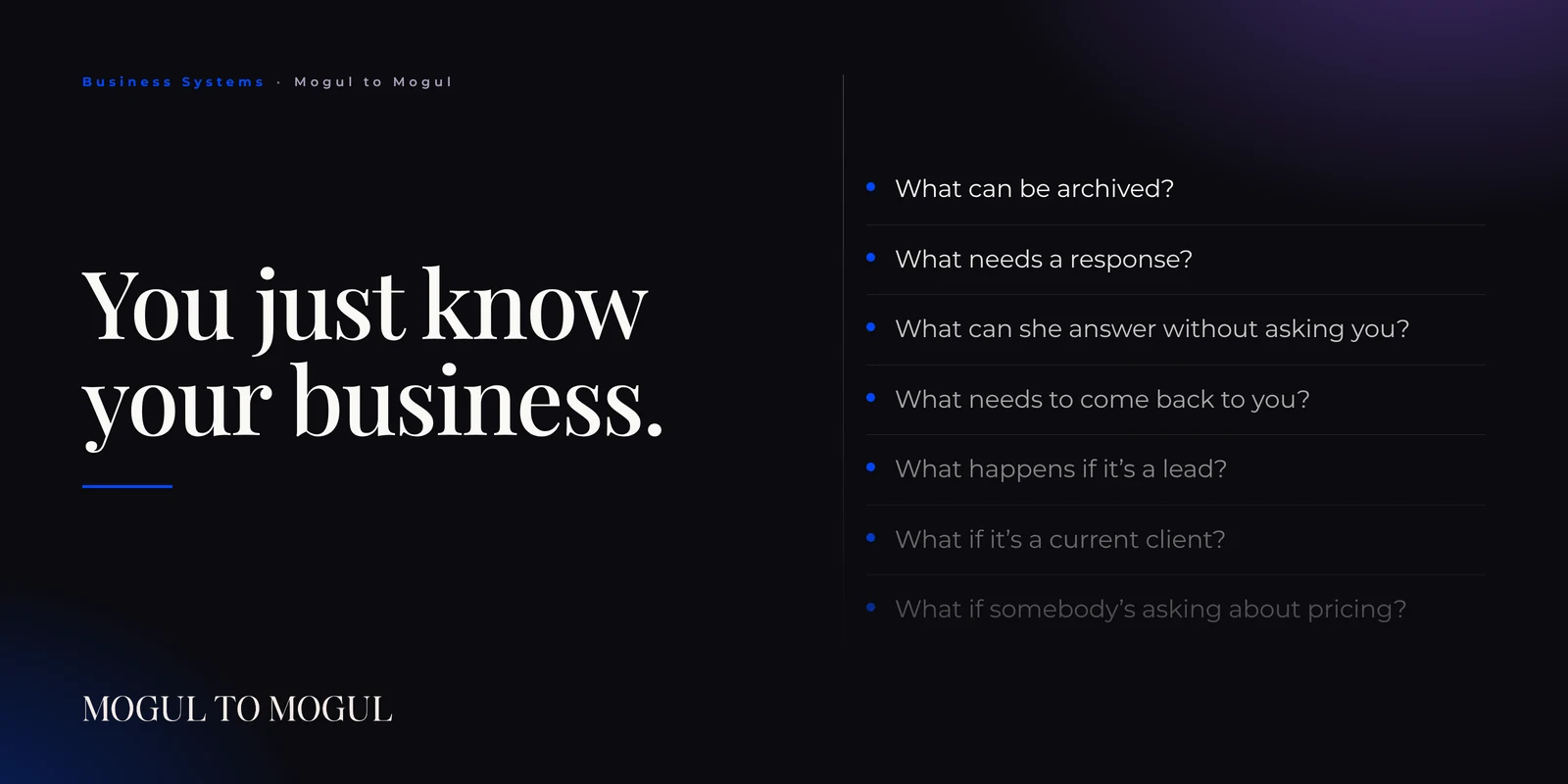
You just know your business.
Then you hire somebody and suddenly all of those little decisions you’ve been making automatically need to be explained to another person. That’s when you start realizing, okay, I thought I had my shit together. My shit together isn’t as put together as I thought.
And hiring is what exposed it.
The email example sounds simple until you actually look at it.
Maybe one of the first things you want your VA to help you with is email. You’re tired of the inbox, you know things are sitting in there and you just want somebody to go in, organize it and clear it out.
Cool. But then you actually look at the setup.
Your contact form on your website is connected to an email address you barely check. You might check it once a month, maybe a couple times a quarter, and now you have no idea how many leads or opportunities you may have already missed. You have personal email mixed with business email, another business email somewhere else, no tagging system and no real way to organize what needs your attention versus what doesn’t.
You know how to navigate all of that because you’ve been doing it. Your VA doesn’t.
So when you say, “Go clear out my email,” what does that actually mean? What can be archived? What needs a response? What can she answer without asking you? What needs to come back to you? What happens if it’s a lead? What if it’s a current client? What if somebody’s asking about pricing?
Those are decisions you were already making. You just didn’t think of them as a system because they were happening inside your head.
“Go clear out my email.”
Decisions you were already making
- What can be archived?
- What needs a response?
- What can she answer without asking you?
- What needs to come back to you?
- What happens if it’s a lead?
- What if it’s a current client?
- What if somebody’s asking about pricing?
The same thing happens when you say you need help managing your clients. Okay, boom. How does this person access the client information? Where are you keeping notes? Where does project management happen? How do they know what stage the client is in? What can go out to a client without your approval, and what actually needs you to approve it first? What happens when something is late or when the client does something that doesn’t fit the normal process?
These are the things you start finding out when you’re actively hiring and trying to get some of this stuff off of you. You thought the problem was that you needed help, but bringing in help is what made you look at how the business actually operates.
This is usually where ownership gets real.
When you’re a solopreneur, you don’t really have to think about ownership because everything belongs to you anyway. You’re the CEO, COO, operations, sales, marketing, client experience and the person doing the actual work. You’re not sitting there all day saying, “Okay, now I’m switching into my Head of Operations role.” You just do what needs to be done.
That’s why I think hiring forces you to acknowledge all the different roles you’ve been playing without even thinking about it.
Because once another person comes in, “help me” isn’t specific enough. What do they actually own? What do you still own? What can they decide without coming back to you? What needs your approval? What information do they need to do the work well? What happens when something changes and the normal instructions no longer apply?
If they can only move when you tell them what to do next, then yes, they may technically have the task, but you still have most of the ownership. And that’s how people end up saying they hired help but somehow feel like they have even more work now. They’re doing their work, answering questions, checking behind somebody else, correcting things and trying to remember what they told them last time.
They may technically have the task, but you still have most of the ownership.
- Do they have the context?
- Do they have access?
- Do they know the boundaries of what they can decide?
- Do they know what finished looks like?
That doesn’t automatically mean you hired a bad VA.
Sometimes the handoff is incomplete because the business was never structured in a way where another person could actually step into it.
I also don’t think the goal is to remove you from your business.
I want to be clear about that because I don’t believe the answer to every systems problem is “the owner should never be involved.”
Some things should stay with you. Your judgment may be part of the value. There may be client relationships you want to stay close to. There may be decisions that really do need your approval, and there may be parts of the experience that are better because you’re involved.
That’s fine.
The issue is when the business depends on your memory, your availability and your constant intervention just to keep moving. That’s different from intentionally choosing where you want to stay involved.
You can own strategy and still have clean handoffs for admin. You can stay close to your clients without being the only person who knows where anything is. You can approve important decisions without approving every email that leaves the business.
So when you hire, I don’t only want you thinking, “What can I give this person?” I want you thinking about what this person actually needs from the business in order to own the work well. Do they have the context? Do they have access? Do they know the boundaries of what they can decide? Do they know what finished looks like?
Because the task alone isn’t enough.
They need enough of the business to actually do the work without pulling you back into every little thing.
And this is exactly why I created the Client Experience Playbook.
A lot of these issues don’t show themselves until something in the business changes. You hire. You get busier. You add more clients. You add a new offer. You start getting more leads. You take on a job while still running your business. Now the way you’ve been operating for the last few years gets tested, and that’s when you find out what’s actually clear, what’s not clear and how much of the business still depends on you.
The Client Experience Playbook helps you sit down and look at all of that together. Not only what your clients are experiencing, but what’s happening behind the scenes to make that experience work, what you’re still personally carrying, how your recurring processes are actually being handled, what happens with communication and how money moves through the experience too.
Because sometimes the problem isn’t that you need another person.
Sometimes you need to understand the business you’re asking another person to step into.
And if hiring has made you realize there’s a lot more living in your head than you thought, I’d look at that before you add another hire, another tool or another workaround.
The Client Experience Playbook is free and fillable.
Go through it with the business you actually have right now, because that’s the business we can actually do something with.