So I built my brain an operating system, and I’m proud as hell of what I built.
Like genuinely.
This whole thing started because I wanted to get more organized. That’s it. I wasn’t sitting around saying, “You know what I need? A custom web app, a WordPress plugin, an MCP connection and a whole operating system for my business.”
Absolutely not.
I was just tired of having my business thoughts everywhere and constantly feeling like I had to remember where I put something, what I decided, what I was working on and which AI already knew what.
I started with ChatGPT. For a long time, I used ChatGPT for damn near everything. Then I started using Claude more because I liked the way Claude naturally pushed back on me. I didn’t have to keep telling it not to agree with everything I said. It would challenge the idea, make me think about something differently, and I liked that.
Over time, though, the way I used both of them started changing. I started liking ChatGPT more for copy, organization and helping me keep my business brain together. And I still loved Claude for building. If I’m creating an app, building a page, working through the technical side of something or I need a second opinion that might tell me my first idea is wrong, I like having Claude in that role.
Which was cool until I realized I had created another problem.
ChatGPT knew one version of my business. Claude knew another. I knew the actual version, but I was the one constantly responsible for catching everybody up.
And I got tired of that.
It started as a ChatGPT Project.
The first version of MOCHA OS was actually pretty simple.
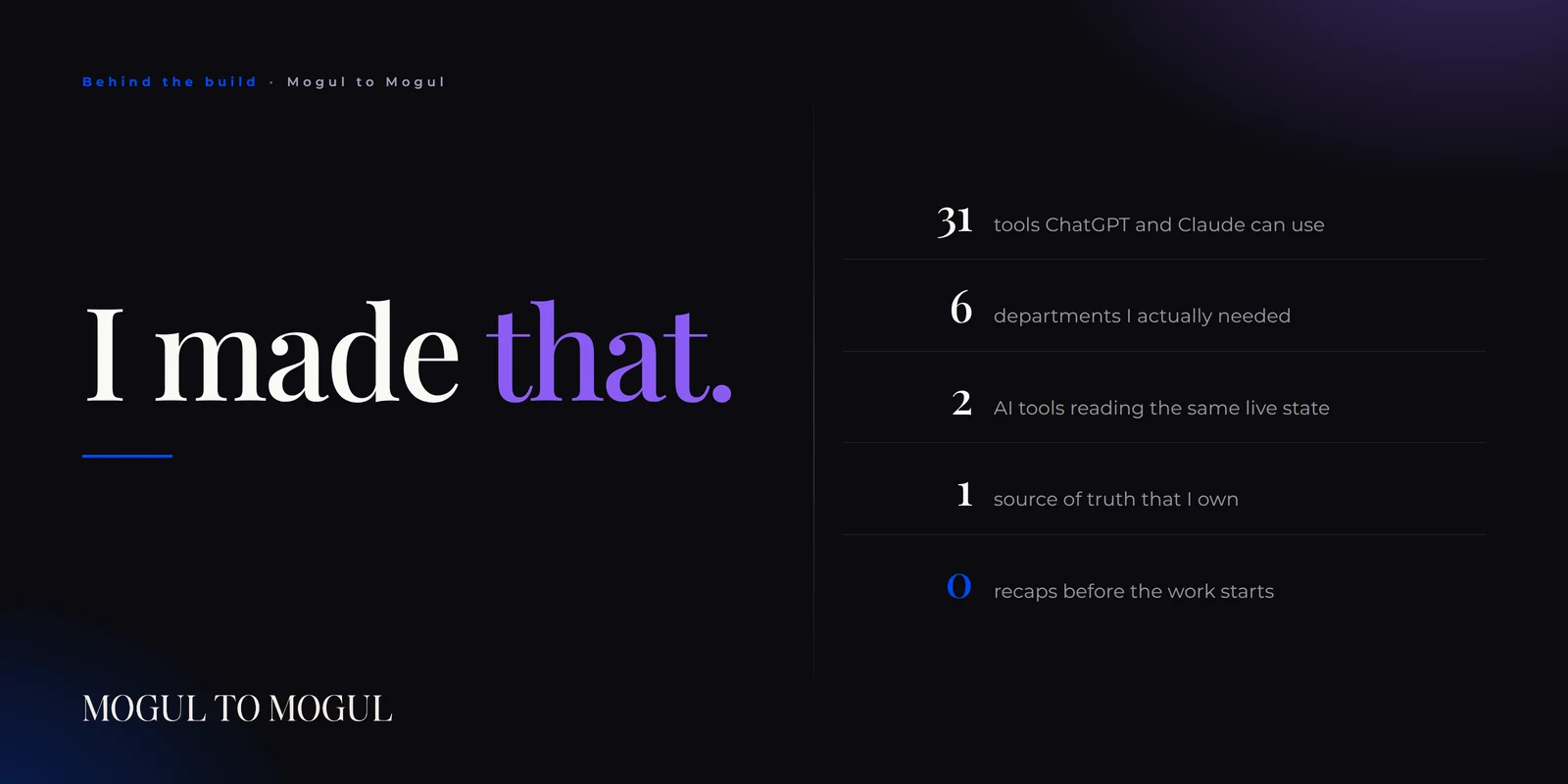
I created a Project inside ChatGPT and named it MOCHA OS. Then I broke the business into the departments I actually needed: 00 HQ, 01 Client Intelligence, 02 Sales + Growth, 03 Content + Visibility, 04 Brand + Creative and 05 Web + Digital Experience.
HQ became the place for my random thoughts, brain dumps, questions and whatever else was in my head that I didn’t feel like organizing before I said it.
That part mattered because I know me.
If I have to stop and figure out where a thought belongs before I can get it out of my head, there’s a very good chance I’m either going to forget it, put it in the wrong place or get distracted trying to organize the thought instead of actually doing something with it.
So the rule became: put it in HQ.
- 00HQHQ figures out what it is, organizes it and creates a handoff to the department that actually owns it.
- 01Client Intelligence
- 02Sales + Growth
- 03Content + Visibility
- 04Brand + Creative
- 05Web + Digital Experience
And for a minute I was like, oh yeah. I did something here.
Because now instead of one giant chat trying to hold my whole business, I had actual lanes. Sales could stay in Sales. Content could stay in Content. Web could stay in Web. Client information had somewhere to go. Decisions weren’t just floating around inside random conversations.
It felt good.
Until it didn’t.
I thought I created structure. I had really created a structured mess.
This is the part that made the whole thing turn into something much bigger.
Because even with the departments, I still had to click into all these different chats. I’d be working on one thing, leave to handle something else, come back later and now I’m scrolling up and down trying to figure out where the hell we left off.
And ChatGPT conversations aren’t a project management system.
If you worked on three different things in the same chat and then came back two days later after working on five other things, you can’t just click “that one project I was working on Tuesday” and pick up where you left off. You’re scrolling. You’re searching. You’re trying to remember what wording you used so you can find it again.
I could feel myself getting overwhelmed with the system I had literally created so I wouldn’t feel overwhelmed.
That’s when I was like, okay, this isn’t done.
And at the same time I still had the Claude problem.
When I needed Claude to build something, I didn’t want to create another summary every single time. I didn’t want to explain the project, the current priorities, the decision we just made, the copy ChatGPT wrote and what we already ruled out just so Claude could get to the starting line.
I was spending too much time transferring context.
So I started thinking, it has to be a way for these things to work from the same information.
Not the same conversation.
The same information.
That distinction is really what changed everything.
Not the same conversation. The same information.
So I built the actual MOCHA OS.
At first, the content side of the business was still living in a spreadsheet. That got turned into a private Content Library on my own website where I could actually see the content, search it, filter it, track what was drafted, ready, scheduled or published and let ChatGPT update it while we worked.
Then I realized content wasn’t the only thing that needed a real home.
I needed the current priorities in there. Projects. Decisions. Things I wanted to come back to later. Questions. Daily briefs. What needed my attention. What we were doing this week versus what absolutely did not need to become a new project because I had another idea at 11:47 at night.
So the Content Library grew into MOCHA OS.
It became a private app hosted on my WordPress site, with the actual live picture of my business sitting behind it.
Now I can open the app and see what I need to do today, what the current priority is, what decisions need me, what projects are moving, what content is supposed to go out and what’s waiting in the inbox.
And the thing I love is I don’t have to mentally rebuild the business every time I open it.
The information is already there.
Then I needed the system to stay updated without me babysitting it.
Because I know myself enough to know that if I built a beautiful app that required me to remember to manually update 17 different fields every time something changed, I was eventually going to stop using the damn app.
I didn’t need another productivity tool to maintain.
I needed something that could actually keep up with the way I work.
So I originally created a custom GPT around MOCHA OS, and then once it made more sense to move toward the plugin setup, I had Claude help me turn the connection into a full plugin system.
I created the connection for ChatGPT and a connection for Claude so both of them could work from the same live state.
Now when I’m inside one of my ChatGPT department chats, it can sync with MOCHA OS, see what’s current, do the work and write the result back.
When Claude needs to build something or give me a second opinion, it can read that same live picture instead of me writing a whole “previously on Mocha’s business” recap first.
That was the moment where I was like, oh shit.
I really built this.
Not because ChatGPT and Claude are talking to each other in some magical little AI group chat. They’re not.
They’re both working from the same source of truth that I own.
And that is so much better.
The part I’m most proud of isn’t even the tech.
Don’t get me wrong, the tech is cool as hell.
MOCHA OS ended up becoming a private WordPress app with its own plugin, 31 tools that ChatGPT and Claude can use, 40 private web endpoints, scheduled runs, a content calendar, project tracking, decisions, handoffs, daily briefs, questions, a change log and all the little things that keep the system from turning back into another pile of information.
At one point, we had gone through 14 releases in about 36 hours.
The system had almost 7,000 lines of code across 15 files.
I typed zero of them.
And I think that’s the part people misunderstand when they talk about AI replacing skill.
I didn’t need to become a developer to build MOCHA OS.
I needed to know what wasn’t working.
I needed to know what I wanted the experience to feel like.
I needed to know what information should live where, who should own what, what needed to happen automatically, what needed my approval and what I absolutely did not want this thing doing.
Then I had to keep looking at what got built and saying, no, that’s not it. This is confusing. That creates more work. I don’t want another button there. I need this to show me what matters first. This doesn’t need its own system. Connect it to the one we already have.
That is the work.
I architected the experience behind the system.
Claude helped build it. ChatGPT helps me operate inside it. But the reason it works for me is because I kept making decisions about how the business should actually function instead of getting impressed by the fact that something technically worked.
And whew, if that isn’t my whole philosophy sitting right there in a real-life case study.
I built something for the way I actually work.
That’s probably the biggest reason I’m so proud of MOCHA OS.
I didn’t go download somebody else’s business dashboard and force myself to use it.
I didn’t add another tool because somebody told me every CEO needs one.
I kept paying attention to the places where I was losing information, repeating myself, getting distracted, clicking around too much, carrying context in my head or creating a process that technically worked but was annoying as hell to actually use.
Then I fixed those things.
And every time the fix created another problem, I fixed that too.
That’s how the ChatGPT Project turned into a Content Library, the Content Library turned into the full operating system, and the operating system turned into something ChatGPT and Claude can both work from without me sitting in the middle translating my own business all day.
- A ChatGPT Project
- A Content Library
- The full operating system
- Something ChatGPT and Claude can both work from
Now my thoughts have somewhere to go.
My projects have a real next step.
My decisions have a history.
My content has a home.
If ChatGPT and Claude disagree, I can actually compare the recommendations instead of trying to remember what each one said.
And when I open the system, I can see the business instead of carrying the whole damn thing around in my head.
I made that.
So yes, I’m going to hype myself up about it.
Because this started with me saying, “I just need to get more organized,” and somehow turned into me architecting a whole private operating system for my business on my own website.
I’m putting the walkthrough with this blog because I want y’all to actually see what I built.
And if you’ve ever wondered what I mean when I say I architect the experience behind the business, this is probably one of the clearest examples I can give you.
I really do love this systems shit.